September 13, 2026
ERC 2026: Sixth Overall, and a Win in Astro-Bio
Our second European Rover Challenge ended with four podium finishes and our first ever category win. Here is how the campaign went.
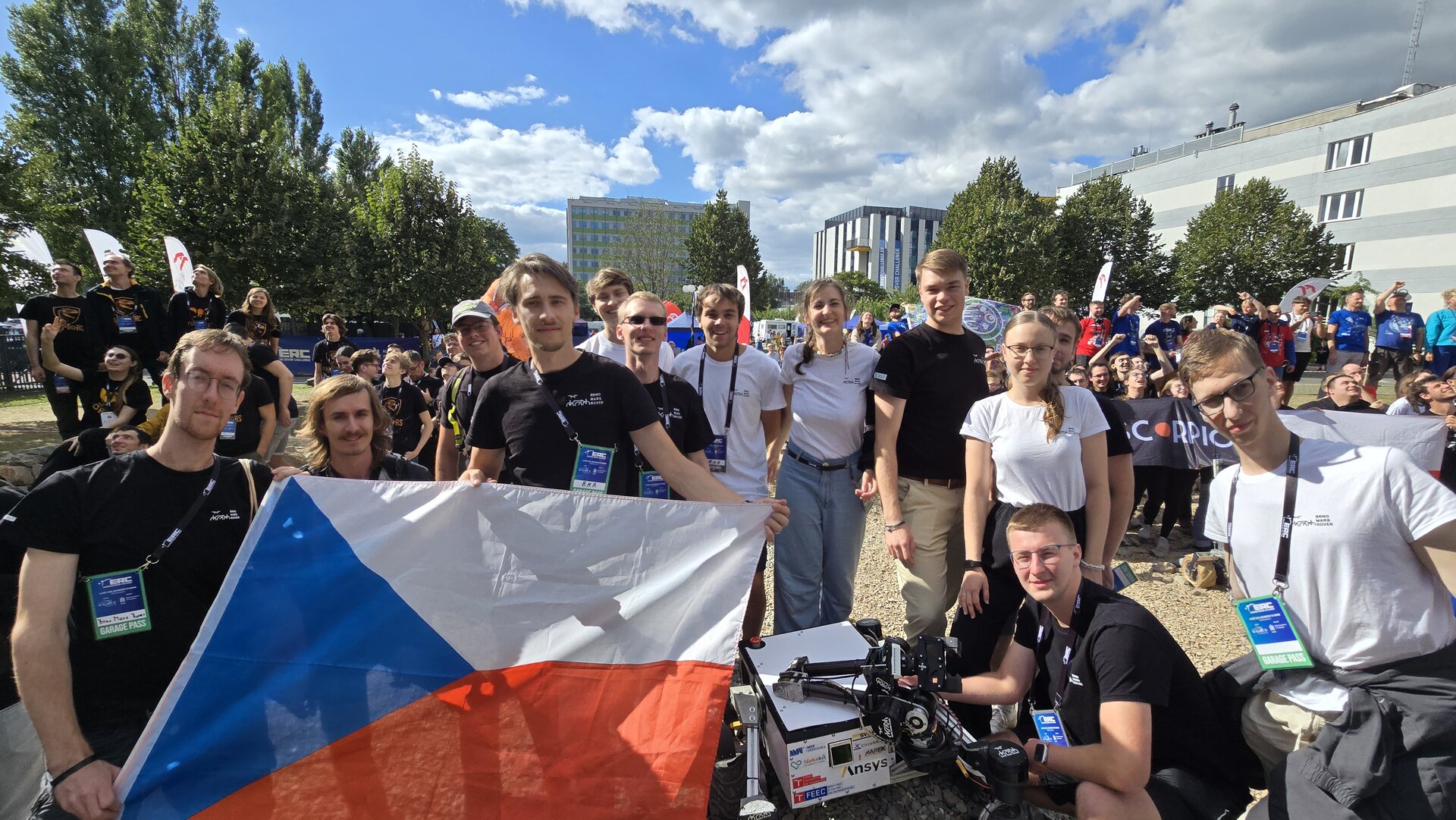
Team BMR at the ERC 2026 finals, AGH University, Kraków
From 4 to 6 September 2026 we were back at AGH University in Kraków for the finals of the European Rover Challenge, the largest planetary robotics competition in Europe. A year earlier we had arrived as complete newcomers. This time we came back knowing what the Mars Yard looks like, and it showed.
Freya finished 6th overall and took four podium places across the sub-tasks, including a first place in Astro-Bio. It is our best result so far, and our first category win.
Getting to the Finals
Qualification for ERC is decided on paper long before anyone drives anything. Teams submit a Preliminary Report and a field performance video, and only the top 25 are invited to Kraków. There were no wildcards this year.
We qualified in 10th place with 229.75 points: 129.75 out of 150 for the Preliminary Report, and a perfect 100 out of 100 for the video. The cut-off for 25th place was 216.75 points, so we cleared the line with room to spare. For context, our report scored 68 out of 100 in 2025 — the written side of the campaign was where we improved the most.
Where We Placed
1st Place: Science — Astro-Bio. Our strongest result of the weekend, and the one we had quietly been building towards all year. The task is run with a custom astrobiology module carried on the rover, which collects and processes a sample through a fixed calibration and measurement sequence rather than simply photographing it.
2nd Place: Science — Exploration. Exploration is scored across three separate deliverables: a regional geology analysis inside the Final Report, a Science Planning Report submitted before the event with a geological map of the Mars Yard and a falsifiable hypothesis, and a final report written on site within two and a half hours of leaving the yard. The points depend on actually testing the hypothesis you committed to weeks earlier.
2nd Place: Navigation — Droning. A repeat of our 2025 silver in the drone task, flown autonomously: take-off, a search pattern over the yard, marker detection and a precision landing, with the high-level mission logic built in MATLAB and Simulink.
3rd Place: Science — Sampling. Drilling and sample handling, where the rover has to collect material from the yard and deliver it intact.
What Changed Since 2025
The obvious difference is the science. In 2025 our podiums came from Drone Navigation and Probing — tasks about driving and flying well. In 2026 three of our four podiums were in Science, which rewards the instruments on the rover and the reasoning behind them rather than the mobility underneath. The astrobiology module and the spectral soil analysis were the parts of Freya that earned the most this year.
The other difference is preparation. A perfect video score and a report nearly forty points better than last year did not happen on the Mars Yard; they happened in the months before it.
What Next
Freya keeps developing, and so does the team. We are students from three faculties of Brno University of Technology — FEKT, FSI and FIT — building a Mars rover alongside our degrees, and we are always looking for people who want to help.
If you study at BUT and any of this sounds like your kind of problem, come and talk to us.